
Canadian black snakeroot
Sanicula canadensis
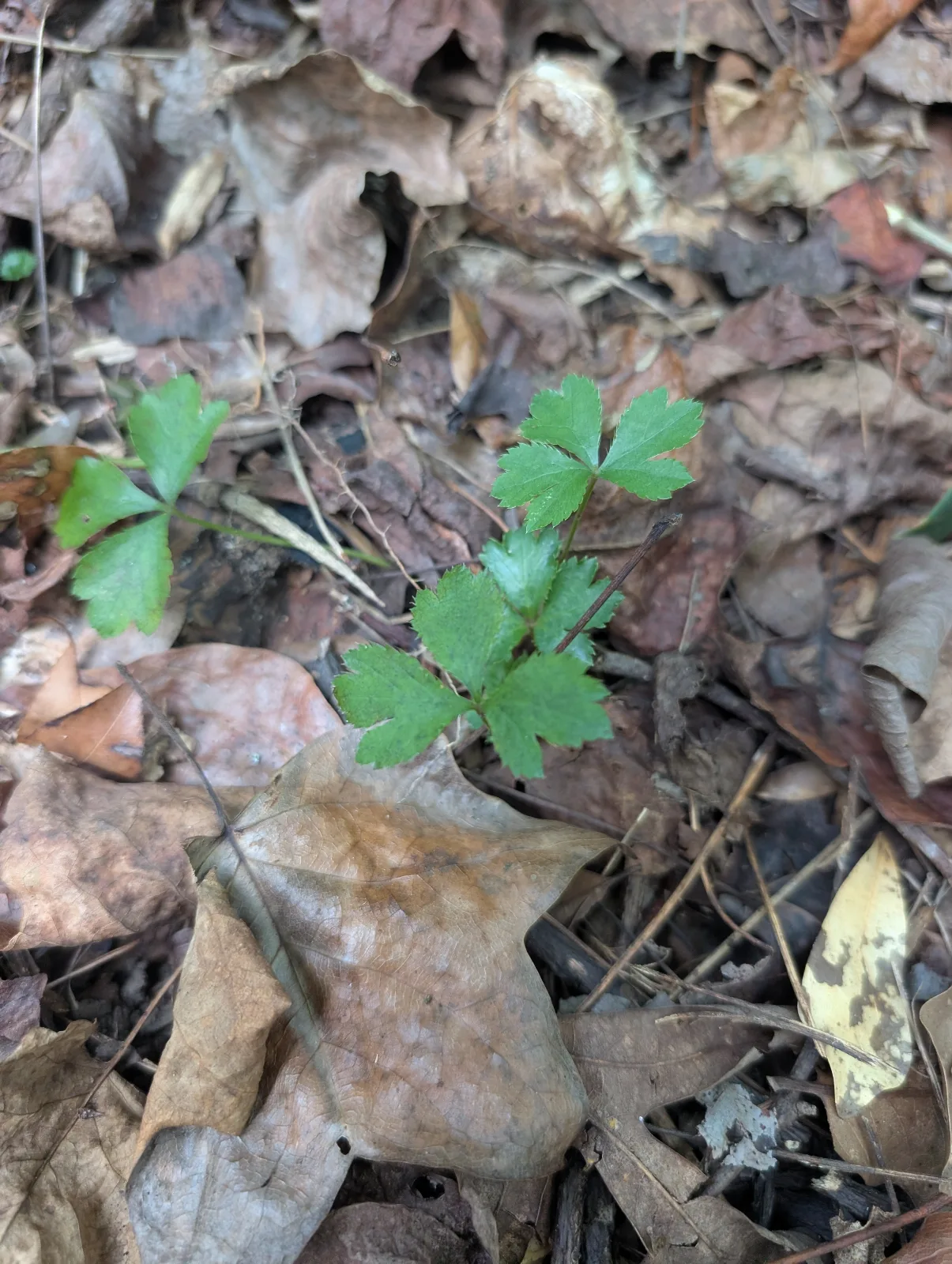
- Blooms
- May to July
- Family
- Apiaceae
The flowers attract few insect pollinators, although occasionally they are visited by Halictid bees (Lasioglossum spp.), masked bees (Hylaeus spp.), and Syrphid flies, which suck nectar.
Has been cited as a host for the black swallowtail butterfly (Papilio polyxenes).
This herbaceous plant is a biennial or short-lived perennial; it is about 1-2' tall, branching occasionally. The stems are glabrous and light green; they are terete or somewhat angular. The alternate leaves are usually trifoliate, although some of the smaller upper leaves are simple. The lower leaves often appear to be palmate with 5 leaflets, but this is because each lateral leaflet has been deeply divided into 2 large lobes. In outline, the lower compound leaves are nearly orbicular in outline (up to 5" wide and 5" across, excluding the petioles) while the upper compound leaves are more narrow. The leaflets and large lobes are obovate, ovate, or broadly elliptic in shape, while their margins are coarsely double-serrated and sometimes cleft along their margins. Leaf venation within each leaflet and lobe is pinnate. The upper leaf surface is yellowish green (in bright sunlight) to dark green (in shade) and glabrous. The lower leaves have long petioles, while those of the upper leaves are much shorter. These petioles are light green, glabrous, and slightly sheathed at their bases; they are grooved above and convex below. (From illinoiswildflowers.info)
Where to see it
Learn more
- Canadian black snakeroot on iNaturalist ↗ (opens in a new tab) · photos and range maps
- Canadian black snakeroot on USDA PLANTS ↗ (opens in a new tab) · the federal plant profile